
You heard it here last – AI is making us stupid.
At least, that is what some people have understood from Microsoft’s recently published study on how generative AI impacts critical thinking. In their study, Microsoft found that knowledge workers who outsource fact-checking and analysis to GenAI might see a long-term decline in their cognitive and critical thinking abilities. GenAI will have a profound impact on research processes, assisting with information gathering and compilation, but also creating new tasks for researchers. Information verification and response integration are two examples mentioned in the study.
I keep thinking about something I heard too long ago to properly credit – that we have our best ideas when we do not actively think about a problem at hand, and that creativity thrives when we are bored. How many times have you had a great idea strike you while in the shower or waiting for the bus? Not wanting to sit with an issue and think about it but immediately opening up ChatGPT to help us not only stunts our critical thinking abilities but also our creative muscles. Connecting different problems beyond an obvious pattern or even realising new patterns beyond the scope of AI is something only humans can do, and how we will continue to innovate and evolve. This feels especially problematic considering school kids are using ChatGPT for their assignments.
There are also doubts regarding GenAI’s ability to produce new knowledge as opposed to simply reiterating existing knowledge, not to mention the reliability of the material generated. For researchers or companies, the lack of copyrightability of generated content should also be considered. Not to say that GenAI doesn’t have its uses, but that it requires what Microsoft describes as “stewardship” – essentially making sure it operates the way it should.
What maybe preoccupies me the most when it comes to GenAI is the ethical side. Not only has it been trained with data without anyone consenting – which I find especially problematic when it comes to image generation, as I would consider myself a creative person – but you also have to deal with bias, possible privacy violations in the data, and generating misinformation.
The artistic community especially has been very vocal about their distaste for generated images, with the possibility of prompting GenAI to generate art based on specific artists’ styles. These artists have not consented to being part of AI training and are resorting to using software to protect their artwork from being used for GenAI training. In Sweden, where I’m based, there are no guidelines for AI-generated books either – and libraries are beginning to receive requests to host books written with AI. Is this the death of creativity? Yet another good quote floating around the internet:
“If you can’t be bothered to write it, why would I bother reading it?”
GenAI is a double-edged sword. It’s something that will become increasingly present in our everyday lives, and we need to learn how to use it. While you could argue that abstaining from generating images through GenAI is mostly from an ethical standpoint, refraining from using GenAI for research and classified data until you know what to look out for to catch inconsistencies is a safety issue.
It’s important to remember that regardless of what GenAI is used, there is always a risk of skewed information. The second we assume that any information is strictly objective, we already have made a grave mistake in our critical thinking. We often associate machine generated anything to be objective, but it is built upon data created by humans which is not objective. With DeepSeek growing in popularity, topics such as censorship and rewriting of history are also discussed on a larger scale, but these risks persist no matter what GenAI is used. This means that it’s risky to use GenAI, especially in education, if you don’t know how to properly vet and critically analyse information you use in other works. Similarly, not everyone realises that you should not input sensitive data into any GenAI.
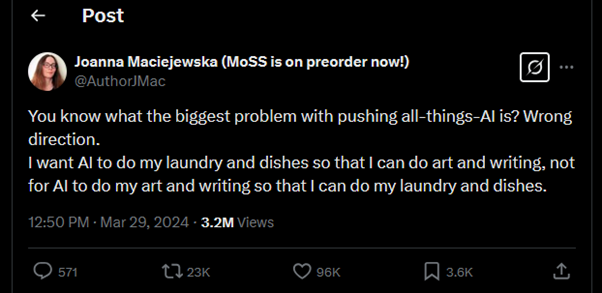
That is not to say that GenAI has no place in our everyday lives. The question is simply how we use it, and what we can allow it to replace. Having ChatGPT plan our weekly meal plans or help us get started on a paper by suggesting readings could prove valuable to us, but using it instead of relying on our own creativity, problem solving skills, and critical thinking skills would be a disservice to the human mind.
Want to read more on this topic? Here are some suggestions:
- ChatGPT maker OpenAI faces a lawsuit over how it used people’s data
- Strengths and weaknesses of Gen AI
- The Cambridge Handbook of the Law, Ethics and Policy of Artificial Intelligence
- The Impact of Generative AI on Critical Thinking: Self-Reported
Reductions in Cognitive Effort and Confidence Effects From a
Survey of Knowledge Workers - What is generative AI?